Disponible en salaen
acceso abierto | Sala Raúl Echegaray

Loading...
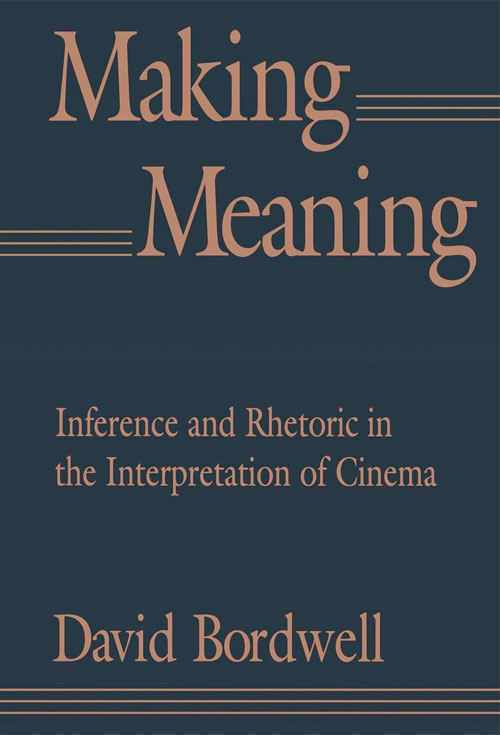
Making meaning: inference and rhetoric in the interpretation of cinema
AÑO
1991
PAÍS DE ORIGENMassachusetts,

Estados Unidos
EDITORIAL O ENTIDAD EDITORA
Harvard University Press
PÁGINAS
334
IDIOMA
Inglés
DONACIÓN
César B. Gogorza
INCORPORADO AL CATÁLOGO
02.07.2026
CONSULTAS
24
SINOPSIS:David Bordwell’s new book is at once a history of film criticism, an analysis of how critics interpret film, and a proposal for an alternative program for film studies. It is an anatomy of film criticism meant to reset the agenda for film scholarship. As such Making Meaning should be a landmark book, a focus for debate from which future film study will evolve.
Bordwell systematically maps different strategies for interpreting films and making meaning, illustrating his points with a vast array of examples from Western film criticism. Following an introductory chapter that sets out the terms and scope of the argument, Bordwell goes on to show how critical institutions constrain and contain the very practices they promote, and how the interpretation of texts has become a central preoccupation of the humanities. He gives lucid accounts of the development of film criticism in France, Britain, and the United States since World War II; analyzes this development through two important types of criticism, thematic-explicatory and symptomatic; and shows that both types, usually seen as antithetical, in fact have much in common. These diverse and even warring schools of criticism share conventional, rhetorical, and problem-solving techniques—a point that has broad-ranging implications for the way critics practice their art. The book concludes with a survey of the alternatives to criticism based on interpretation and, finally, with the proposal that a historical poetics of cinema offers the most fruitful framework for film analysis.
“It’s hard to avoid superlatives when talking about David Bordwell’s work. Let me simply say that here is a book which, for lucidity, breadth, erudition, and rigor, only he could have written. It addresses and analyzes interpretive practice in a way that only the most self-absorbed critic can ignore, and then only at his or her own risk”
– Seymour Chatman, Film Quarterly
“[Bordwell] approaches the issue with his characteristically refreshing candor, clarity, and wit, proceeding from the direct question, ‘How do film interpreters actually come up with the meanings at which they arrive?’ …The controversies sure to be ignited by Making Meaning, in the short run, will be anything but dull; in the long run, its contributions to the development of film poetics will be of even greater import”
– Herb Eagle, Wide Angle
“An A-list historian and theorist himself, Bordwell is the unchallenged capo di tutti capi of academic film studies… His industrial-strength overview is a streamlined and steady Eurail pass through the Continental modes of thought that have dominated the American university since the late ’60s”
– Thomas Doherty, Boston Phoenix Literary Supplement
¿Cree que algún dato de esta ficha fue omitido o es erróneo?
Envíenos su sugerencia mediante el
formulario de contacto.
 ¡Estás usando un navegador desactualizado!